Clear Span vs Columns: How Width Affects Cost
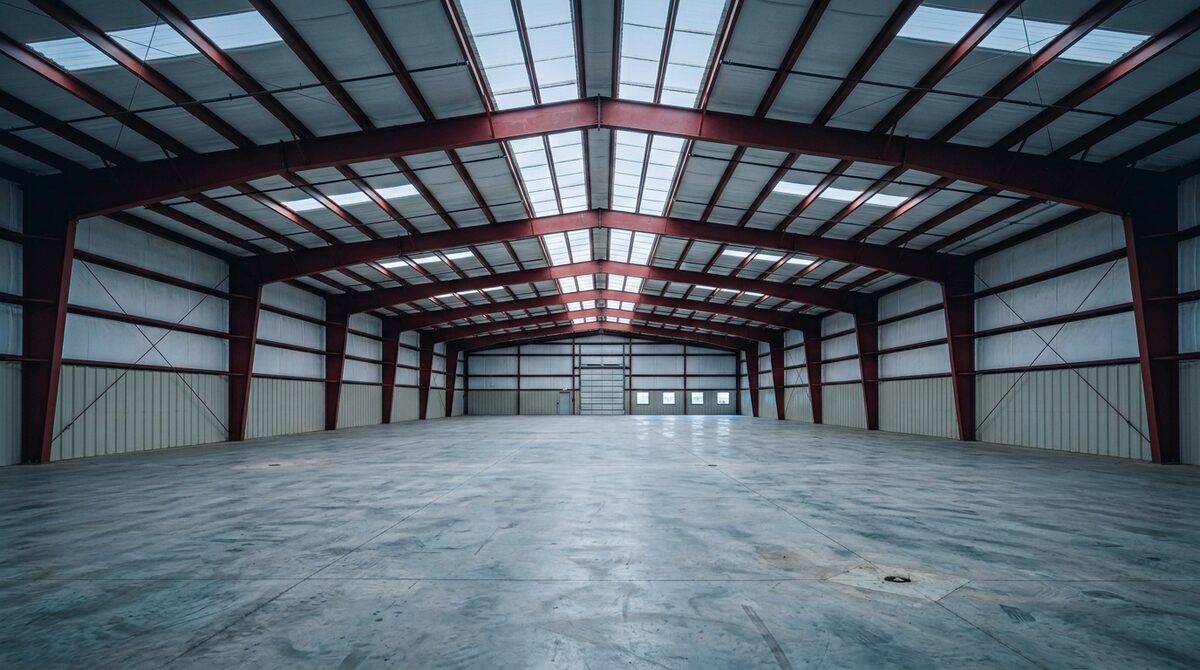
Clear span is the single biggest cost driver that building buyers underestimate. It's the distance from one sidewall to the other with no columns in between — and once you push past certain thresholds, the price per square foot climbs fast. Not linearly. Exponentially.
This isn't a trick to upsell you on a smaller building. It's physics. Wider unsupported spans need deeper, heavier rafters. The steel tonnage goes up, the foundation gets bigger, and the cost follows. Knowing where the breakpoints are helps you make a smarter decision about whether you truly need that open floor plan or whether a few strategically placed columns could save you tens of thousands of dollars.
How clear span works in a steel building
A pre-engineered metal building uses rigid frame construction. Picture a steel portal frame — two columns and a tapered rafter connecting them at the top, forming the shape of the building's cross-section. That frame repeats every 20 to 30 feet down the length of the building. The wider the span between the columns, the more bending force the rafter has to resist.
Engineers handle that force by making the rafter deeper (taller in cross-section) and using thicker flanges and webs. A 60-foot clear span rafter might be 24 inches deep at the knee. A 200-foot clear span rafter could be 72 inches or more — that's 6 feet of steel depth just for the rafter.
More depth means more material. More material means more weight. More weight means bigger columns, bigger foundations, and a bigger freight bill. That's the cascade that turns a simple "I want it wider" request into a budget conversation.
The cost curve by width
Not every additional foot of width costs the same. The relationship between clear span and cost has distinct zones:
| Clear span range | Cost behavior | Typical rafter depth |
|---|---|---|
| Up to 80 ft | Efficient. Most economical range for clear span | 18" - 30" |
| 80 - 150 ft | Moderate increase. Cost per SF rises noticeably | 30" - 48" |
| 150 - 200 ft | Steep increase. Rafters get significantly deeper | 48" - 72" |
| 200 - 300 ft | Very expensive. Rafters can exceed 6-10 feet deep | 72" - 120"+ |
Up to about 80 feet, clear span is the standard approach and the most cost-effective way to build. Most shops, garages, small warehouses, and commercial buildings fall in this range. You get a column-free interior without paying a premium for it.
Between 80 and 150 feet, clear span still works fine but you start paying more per square foot. The rafters are deeper, the columns are heavier, and the foundations need more concrete. A 120-foot clear span warehouse will cost noticeably more per square foot than a 60-foot one, even if the total square footage is the same.
Above 150 feet is where the math gets uncomfortable. A 180-foot clear span hangar isn't just "a little more" than a 120-foot building. The rafter depth might double. The steel weight per frame could triple. And every one of those frames repeats every 25 feet down the building length.
When columns make sense
Interior columns get a bad reputation, but they're an incredibly effective tool for controlling cost. A single row of columns down the center of a 120-foot-wide building converts it from a 120-foot clear span into two 60-foot spans. That's the difference between the "moderate increase" zone and the "most economical" zone.
The savings can be dramatic. On a large building, adding a center column row might reduce the steel package cost by 20 to 35 percent. The columns themselves are inexpensive compared to the rafter steel they eliminate.
Columns work well when:
- The building is used for storage: Racking can be arranged around columns. Most warehouse racking systems are designed to work with column grids
- Manufacturing floor layouts are flexible: Production lines can route around columns if you plan the layout during design
- Multi-use buildings: Put the column line at the boundary between zones — workshop on one side, storage on the other
- Cost is the priority: If you're trying to maximize square footage per dollar, columns are your friend
When you need true clear span
Some uses simply cannot tolerate columns. There's no way around it, and the premium is worth paying.
- Aircraft hangars: Planes need to roll straight in. A column in the middle of a hangar isn't a nuisance — it's a hazard. Hangars are the classic clear span application
- Indoor riding arenas: Horses and columns don't mix. Standard arena sizes run 80x200 to 100x300, all clear span
- Sports facilities: Indoor soccer fields, basketball courts, batting cages — anything with a playing surface needs unobstructed space
- Event venues: Wedding barns, conference halls, and entertainment spaces need flexible open layouts
- Large vehicle maintenance: Fire stations, fleet maintenance bays, and heavy equipment shops where overhead cranes travel the full width
If your use case is on this list, budget for the clear span cost and don't try to shortcut it with columns. The function of the building demands the open space.
The hybrid approach
Some of the smartest building designs we see use a hybrid layout. Clear span where it matters, columns where it doesn't.
A common example: an 80-foot clear span shop bay in the front for vehicle work, connected to a 120-foot-wide storage area in the back with a center column row. The shop gets full open space for lifts and overhead cranes. The storage area gets maximum square footage at minimum cost. One building, two structural approaches, optimized for both function and budget.
Another approach is using a lean-to addition off one sidewall. The lean-to shares the main building's sidewall column, giving you extra width without increasing the clear span. A 60-foot clear span building with a 20-foot lean-to gives you 80 feet of usable width — but the structural cost is closer to 60 feet plus a simple shed frame.
We show side-by-side pricing on every quote so you can see exactly what clear span is costing you versus a column alternative. Most buyers are surprised by how much they can save with a small layout adjustment.
Wondering what your width will cost?
Send us your dimensions and we'll quote it both ways — clear span and with columns — so you can compare the numbers and decide what's worth it.
Get Your Free Quote