Insulation: Blanket vs Spray Foam vs IMP
Here's the thing most people get wrong about steel building insulation: all three common options hit roughly the same R-value. A 6-inch fiberglass blanket, 2 inches of closed-cell spray foam, and a 3-inch insulated metal panel all land around R-19 to R-21. The performance is nearly identical. What separates them is cost, durability, installation speed, and how the finished building looks.
Picking the wrong insulation isn't a comfort problem — it's a money problem. You'll either overspend on a system you don't need or underspend on one that fails in five years. This guide breaks down each option honestly so you can match your insulation to your budget and your building.
Blanket fiberglass
Fiberglass blanket insulation is the workhorse of the steel building industry. It's been the default for decades, and there's a reason: it works and it's cheap.
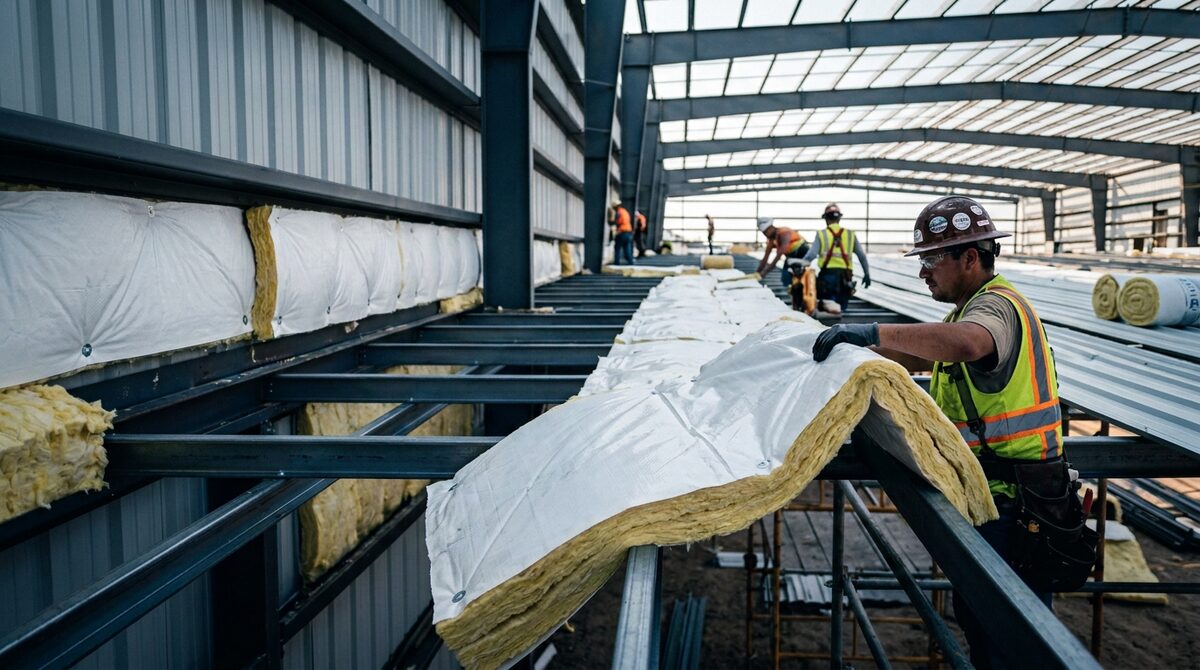
Standard steel building blanket insulation comes in 6-inch rolls (R-19) faced with a white vinyl laminated scrim (WLS) that acts as a vapor retarder and gives the interior a clean, finished look. The blanket drapes over the purlins and girts before the exterior metal panels go on — panels compress the blanket at each purlin, creating a "quilted" appearance on the inside.
- R-value: R-19 for single layer (6"). Double layer systems hit R-30 to R-38 by adding a second layer over the purlins
- Cost: Lowest of the three. Typically $1.50 to $2.50 per square foot installed
- Pros: Affordable, readily available, easy for erection crews to install alongside panels, good fire rating
- Cons: Compresses at purlins (thermal bridging), can absorb moisture if vapor barrier is damaged, quilted look isn't for everyone, dust and fibers during install
- Lifespan: 20-30 years if kept dry. Moisture is the enemy — wet fiberglass loses its R-value and grows mold
Blanket fiberglass is the right choice when budget is the primary constraint and the building doesn't need a polished interior appearance. Warehouses, storage buildings, and agricultural buildings almost always use fiberglass.
Spray foam (closed-cell)
Closed-cell spray polyurethane foam (SPF) gets applied directly to the interior surface of the metal panels after the building shell is up. It expands on contact, filling every gap, seam, and fastener penetration. Two inches delivers roughly R-13 to R-14 per inch, putting a 2-inch application right around R-13. You need about 3 inches to match the R-19 of fiberglass — and most contractors spray 3 inches as standard.
- R-value: R-6.5 to R-7 per inch. 3 inches gives R-19 to R-21
- Cost: Mid-range. Typically $2.50 to $4.50 per square foot installed (depending on thickness)
- Pros: Seamless air barrier (no gaps, no thermal bridging), adds structural rigidity to panels, doubles as vapor barrier, excellent moisture resistance
- Cons: Requires specialized subcontractor, building shell must be erected first (delays the schedule), difficult to repair if damaged, can off-gas during application
- Lifespan: 30+ years. Doesn't sag, settle, or absorb water
Spray foam shines in climate-controlled buildings where air infiltration matters. If you're air conditioning a shop in Texas or heating a building in Minnesota, the seamless air barrier pays for itself in energy savings within a few years. It also works well when condensation control is a concern — coolers, wash bays, indoor pools.
Insulated metal panels (IMPs)
Insulated metal panels are the premium option. An IMP is a sandwich — two metal skins bonded to a rigid foam core (usually polyisocyanurate or mineral wool). The panel is the wall. No separate insulation step, no exposed fasteners on the interior, no quilted look.
- R-value: R-6 to R-8 per inch of core. A 3-inch panel delivers R-20 to R-24
- Cost: Highest. Typically $8 to $16 per square foot installed, depending on thickness and finish
- Pros: Best thermal performance (no bridging at all), fastest install (panel + insulation in one step), cleanest interior finish, excellent for food-grade and pharmaceutical environments, easy to clean
- Cons: Expensive, limited color/profile options compared to standard panels, panel joints require careful detailing to maintain air barrier, damage to a panel means replacing the whole section
- Lifespan: 30-40+ years. Foam core doesn't degrade. Metal skins protect it from damage and UV
IMPs are the go-to for cold storage, food processing, clean rooms, and any building where interior appearance and hygiene matter. They're also popular with owners who simply want the best-looking building possible. An IMP interior looks like a finished wall — no exposed purlins, no visible insulation.
Side-by-side comparison
| Blanket fiberglass | Spray foam | Insulated metal panels | |
|---|---|---|---|
| Thickness for ~R-20 | 6" | 3" | 3" |
| Installed cost (per SF) | $1.50 - $2.50 | $2.50 - $4.50 | $8 - $16 |
| Thermal bridging | Yes (at purlins) | None | None |
| Air sealing | Poor | Excellent | Very good |
| Interior appearance | Quilted vinyl facing | Textured foam (can be painted) | Smooth, finished wall |
| Install timing | During erection | After shell is up | During erection |
| Best for | Budget builds, storage | Climate-controlled shops | Cold storage, retail, premium |
Minimum R-values for heated and cooled buildings
If your building will have heating or air conditioning, there are practical minimums you shouldn't go below — regardless of what local code technically allows. Under-insulating a conditioned building is a mistake you'll pay for every month in utility bills.
- Walls: R-19 minimum. R-25 to R-28 recommended for fully conditioned spaces
- Roof: R-30 minimum. R-38 to R-40 recommended. Heat rises — the roof is where you lose it
- Double layer systems: For high-performance buildings, a double layer of fiberglass (one between purlins, one over them) eliminates thermal bridging and can reach R-38+ at a fraction of the IMP cost
Your climate zone and local energy code will set the baseline. But the code is a minimum, not a recommendation. In cold climates, going above code R-values pays for itself in 3 to 5 years.
How to pick the right one
Forget R-values for a minute. You already know they're all roughly equivalent. Ask yourself these three questions instead:
- What's my budget? If cost is tight, fiberglass gets you insulated. No shame in it — the majority of steel buildings use blanket insulation. It does the job
- How important is air sealing? If you're running HVAC and want to minimize energy waste, spray foam's seamless coverage is worth the premium
- Does the interior need to look finished? If clients, customers, or inspectors will see the inside of your building, IMPs give you a wall that looks like drywall without the drywall
Most of the buildings we quote use fiberglass in areas that don't need to look pretty (back warehouse, storage bays) and upgrade to spray foam or IMPs in conditioned or visible areas (offices, showrooms, food prep). Mixing insulation types within one building is common and smart.
Try our interactive insulation comparison tool to see how each option affects your project's cost and specifications.
Need help choosing insulation?
Tell us your building size, location, and how you plan to use it. We'll recommend the insulation type and R-value that makes the most sense for your project and your budget.
Get Your Free Quote