Wind and Snow Loads: What You Need to Know
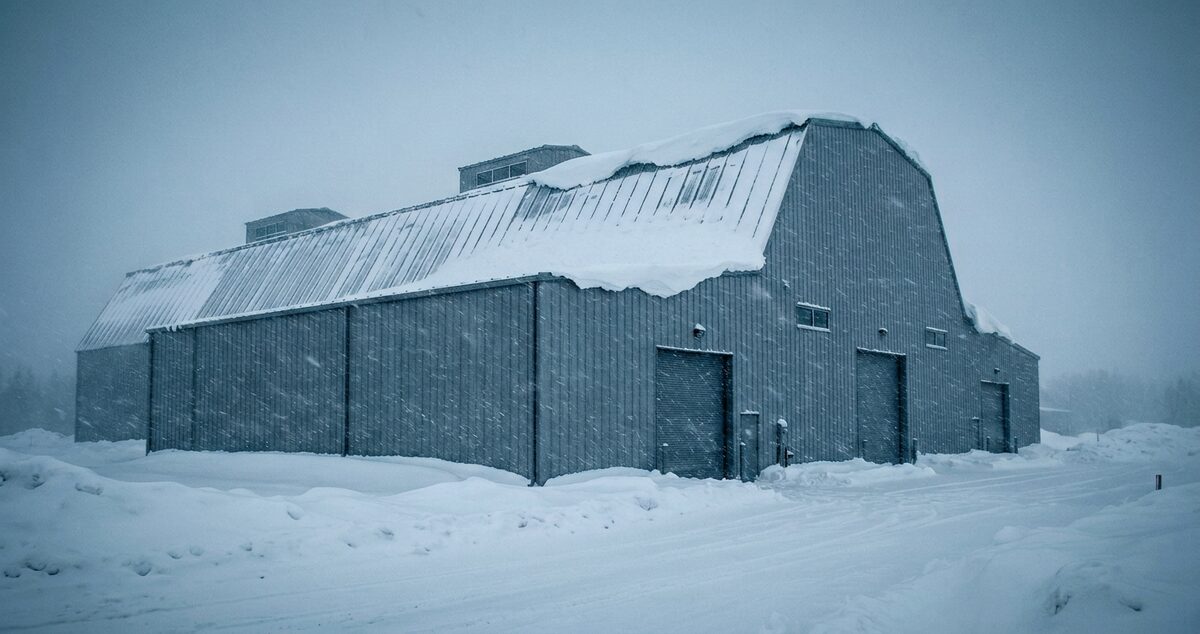
Your building doesn't just hold up its own weight. It has to resist wind trying to rip the roof off, snow piling up on top, and in some regions, the ground shaking beneath it. These forces — called design loads — determine how much steel goes into your building. And more steel means higher cost. There's no negotiating with physics.
Most building buyers hear "wind speed 115 mph" or "ground snow load 40 psf" and their eyes glaze over. Fair enough. But these numbers directly affect your bottom line, and knowing the basics helps you understand why a building in Montana costs more than the same building in Georgia — even if they're identical in size and layout.
What design loads are and where they come from
Design loads are the forces your building must withstand without failing. They come from building codes, which reference a standard called ASCE 7 (published by the American Society of Civil Engineers). ASCE 7 maps out the expected wind speeds, snow loads, and seismic activity for every location in the country.
The three main loads that affect steel building design:
- Wind speed: Measured in miles per hour (mph). This is a 3-second gust speed — the fastest wind burst the building must handle. Most of the US falls between 110 and 150 mph. Coastal and hurricane zones can hit 170+ mph
- Ground snow load: Measured in pounds per square foot (psf). This is the weight of snow on flat ground, not on the roof. The engineer converts ground snow load to roof snow load using factors for roof slope, exposure, and thermal conditions. Common values range from 0 psf (southern states) to 80+ psf (mountain regions)
- Seismic load: Based on soil type and proximity to fault lines. Most steel buildings handle seismic forces well because steel is ductile — it bends before it breaks. But high-seismic zones still add cost through heavier connections and bracing
Your building's loads are set by its geographic location. You don't get to choose them. The local building department enforces compliance, and no reputable manufacturer will engineer a building below code requirements.
Wind loads and exposure categories
Wind load calculations aren't just about the speed number. Two buildings with the same wind speed rating can have very different structural requirements depending on their exposure category.
ASCE 7 defines three exposure categories based on surrounding terrain:
- Exposure B: Urban and suburban areas. Buildings, trees, and other structures break up the wind before it reaches your site. This is the most sheltered category and produces the lowest wind pressures
- Exposure C: Open terrain with scattered obstructions. Flat farmland, open fields, grasslands. Most rural steel buildings fall here. Wind has less friction slowing it down, so pressures are higher than Exposure B
- Exposure D: Flat, unobstructed coastline. Shorelines exposed to open water for a mile or more. This produces the highest wind pressures and requires the most steel
The same 130 mph wind speed generates significantly more force on an Exposure D building than an Exposure B building. A building on the Texas coast (Exposure D, 150 mph) needs substantially more steel than the same building 50 miles inland (Exposure C, 130 mph). The size didn't change. The terrain did.
Here's where it gets tricky: most building departments assign the exposure category, not the building owner. And they tend to be conservative. If your site is on the edge between B and C, expect them to call it C.
Risk categories and importance factors
Not all buildings are created equal in the eyes of the code. A storage shed and a hospital have very different consequences if they fail. Building codes account for this using risk categories:
| Risk category | Building types | Impact on design |
|---|---|---|
| I | Low-risk structures (agricultural, minor storage) | Lowest loads. Reduced importance factor |
| II | Standard occupancy (offices, warehouses, shops, retail) | Baseline. This is where most buildings land |
| III | High occupancy (schools, churches, 300+ person assembly) | Higher loads. 10-15% more steel than Category II |
| IV | Essential facilities (hospitals, fire stations, emergency shelters) | Highest loads. Designed to remain functional after extreme events |
The risk category applies an importance factor to all design loads. For a Category II building (the standard), the importance factor is 1.0. Category III bumps it to 1.15 for snow and wind. Category IV goes to 1.30. That means a Category IV building in the same location as a Category II building is designed for 15 to 30 percent higher loads — which translates directly to more steel.
Most commercial and industrial steel buildings are Category II. But if your building has a specific occupancy that pushes it higher, expect the quote to reflect that.
How loads affect steel weight and cost
Here's the part that matters to your wallet. Higher loads require:
- Deeper rafters: More bending resistance to handle heavier roof loads (snow) and uplift (wind)
- Heavier columns: Wider flanges and thicker webs to transfer loads to the foundation
- More bracing: Rod bracing, portal frames, or moment connections to resist lateral wind forces
- Bigger foundations: Higher loads push more force into the ground. That means wider footings and more rebar
- Heavier secondary framing: Purlins and girts (the members between main frames) also beef up as loads increase
To put numbers on it: a standard 60x100x16 building in a low-load area (115 mph wind, 20 psf snow) might have a steel package weight around 18,000 to 22,000 pounds. The same building in a high-load area (150 mph wind, 60 psf snow) could weigh 28,000 to 35,000 pounds. That's 40 to 60 percent more steel for the same building dimensions.
Steel is priced by the ton. More tons, higher price. There's no engineering shortcut that avoids this. The loads are what they are.
Common misconceptions
After quoting hundreds of buildings, these are the misunderstandings we run into most often:
- "My neighbor's building was cheaper — can't you match it?" Maybe their building had lower loads (different exposure category, different use), a smaller span, or was quoted when steel prices were lower. Comparing raw prices between buildings without matching the engineering is meaningless
- "I don't need that much wind rating — it never blows that hard here." The design wind speed isn't the average wind. It's the extreme gust the building must survive over its lifespan. Building codes aren't suggestions. If the code says 130 mph, the building gets designed for 130 mph
- "Can we use a lighter gauge to save money?" Secondary members (purlins, girts, panels) do come in different gauges. But the gauge is determined by the load calculations, not the budget. Using lighter material than the engineering requires is a code violation — and a liability nightmare
- "Snow doesn't stay on a metal roof." Partially true. Snow slides off steep metal roofs faster than shingle roofs. But the engineer still has to design for the full snow load because the code requires it. Snow sliding is unpredictable and doesn't happen uniformly. Drift loads at parapets and adjacent structures can actually exceed the ground snow load
- "I'll never have an earthquake here." Maybe not a big one. But seismic design requirements exist even in low-risk zones. The good news: steel buildings are naturally good at resisting seismic forces. For most locations outside the West Coast and New Madrid zone, seismic loading doesn't add significant cost
What this means for your project
You don't need to become a structural engineer to buy a steel building. But you should know your site's basic load requirements before you start comparing quotes. Two quotes for a "60x100 building" mean nothing if one is designed for 115 mph / 20 psf and the other for 140 mph / 50 psf. The second building has way more steel in it.
When you request a quote from us, we look up the exact loads for your building site using your address and the current ASCE 7 maps. Every quote we produce lists the design loads on the first page — wind speed, exposure category, ground snow load, seismic parameters, and risk category. No guessing, no surprises.
Under-engineering a building to save money is never the answer. A building that fails in a wind event or collapses under snow doesn't just cost more to replace. It puts people at risk. The loads are the loads. Build for them.
Want to know your site's load requirements?
Give us your building location and we'll pull the exact wind, snow, and seismic design loads for your site. It's part of every quote we produce — no charge, no obligation.
Get Your Free Quote