Frame Types Explained: Choosing the Right Structure
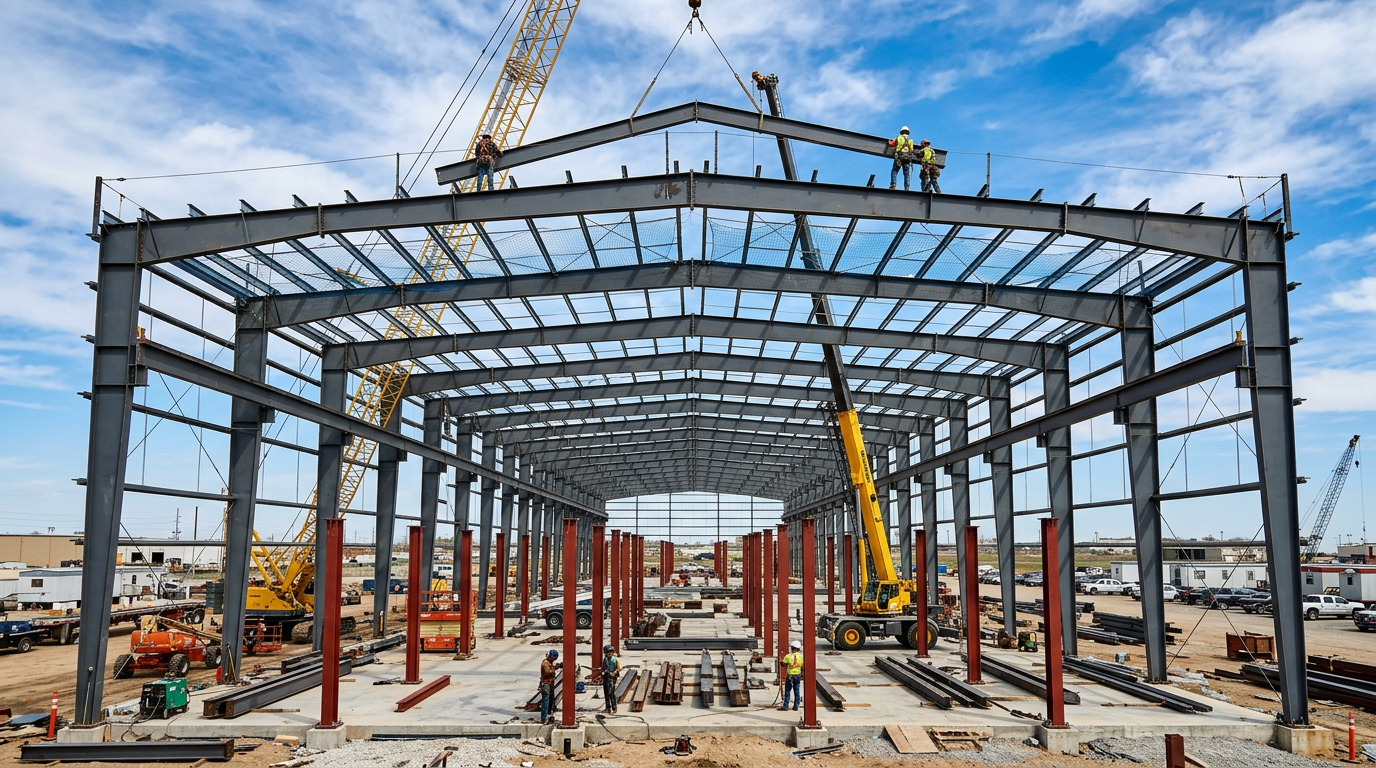
Every steel building starts with a frame — the structural skeleton that determines how wide you can go, how much it costs, and what you can do inside. Choosing the right frame type isn't just an engineering decision. It's a budget decision, a layout decision, and often the single choice that locks in everything else about your project.
There are six common frame types in pre-engineered metal buildings. Each has a different cost profile, span range, and set of trade-offs. Understanding them before you request quotes means you'll know why one vendor prices a building differently than another — and whether a small design change could save you real money.
Clearspan rigid frame
This is the frame most people picture when they think "steel building." Two columns connected by tapered rafters at the top, forming a wide-open interior with zero interior columns. The rigid moment connections at the column-to-rafter joints (the "knees") are what give the frame its strength.
Span range: 40 to 300+ feet.
Best for: Aircraft hangars, sports arenas, riding arenas, event venues — anywhere you need unobstructed floor space.
Clearspan is the premium choice. The wider you go, the deeper and heavier the rafters need to be. Up to about 80 feet it's very cost-effective. Past 150 feet, rafters can exceed 6 feet of depth and the price per square foot climbs steeply. But for many use cases, there's simply no substitute for a column-free interior.
Modular rigid frame
Take the clearspan concept and add interior columns to break the width into smaller spans. Each span behaves like its own mini rigid frame, dramatically reducing the rafter depth and steel weight needed for a given total building width.
Span range: 30 to 80 feet per module.
Best for: Large warehouses, manufacturing plants, distribution centers.
If you need a 120-foot-wide building, a modular frame with two 60-foot spans costs significantly less than a 120-foot clearspan — often 20 to 35 percent less in steel alone. Columns sound like a compromise, but in warehouses and manufacturing, racking and equipment layouts can work around them easily. It's the workhorse frame type for commercial and industrial buildings.
Single slope
One side is taller than the other, creating a single-direction roof pitch instead of the traditional peak. The high side acts as the primary structural element while the roof drains cleanly in one direction.
Span range: 30 to 120 feet.
Best for: Commercial buildings, solar-ready structures, retail facilities, buildings that connect to an adjacent wall.
Single slope has become increasingly popular for modern commercial aesthetics and for buildings designed with rooftop solar in mind — a south-facing slope at the right pitch maximizes panel efficiency. The asymmetric profile also works well when you need a high wall on one side for overhead doors or loading access.
Lean-to
A lean-to attaches to an existing building, sharing one wall. It's essentially half of a single slope frame — one column line on the open side, the other side connected to the parent structure. The roof pitches away from the main building.
Span range: 20 to 60 feet.
Best for: Building expansions, loading docks, covered storage areas, covered work zones.
This is the most cost-effective way to add floor space to an existing building. You're only buying half the columns and one wall instead of four. A common combination: a 60-foot clearspan main building with a 20-foot lean-to on one side gives you 80 feet of usable width at a fraction of the clearspan cost.
Tapered beam
The simplest frame type. Straight columns support tapered I-beams that span between them. Unlike rigid frames, the column-to-beam connections aren't moment-resistant — they're simpler pinned connections. The beam does all the spanning work.
Span range: Under 60 feet.
Best for: Small workshops, storage buildings, agricultural buildings.
Tapered beams are the economy option for smaller buildings. The simpler connections mean less engineering, less steel, and faster fabrication. If your building is under 60 feet wide and you don't need to push large clear heights, this frame type delivers the best dollar-per-square-foot value.
Non-symmetrical
The ridge line is offset from center, creating unequal roof slopes — one side longer, one side shorter. This gives you different eave heights on each side of the building within a single structural frame.
Span range: 40 to 150 feet.
Best for: Mezzanine buildings, crane buildings, mixed-use facilities.
Non-symmetrical frames solve a specific problem: when you need different clearance heights on different sides. A building with a crane on one side might need 30 feet of clear height for the hook, but only 16 feet on the other side for offices or storage. Offsetting the ridge gives you that flexibility without building two separate structures.
How to choose: the decision comes down to three questions
- Do you need a column-free interior? If yes, you're looking at clearspan rigid frame. If columns are acceptable, modular rigid will save you money on wider buildings.
- Are you building new or expanding? Lean-to is the clear winner for additions. New standalone buildings start with clearspan, modular, or single slope.
- What's your width? Under 60 feet, tapered beam is the most economical. 60 to 150 feet, clearspan or modular. Over 150 feet, expect to pay a premium for clearspan — or consider modular with strategic column placement.
See them in 3D
Our interactive frame type explorer lets you view each structure from every angle with 3D models, span comparisons, and side-by-side specifications.
Explore Frame Types in 3DWhat this means for your quote
Frame type selection drives a significant portion of your building's final price. When you upload plans to Steel Contractors, our system identifies the frame type, cross-references it with your dimensions and loads, and prices it through multiple manufacturers. If a different frame type could save you money without compromising your use case, we'll show you both options so you can make an informed decision.
Most buyers don't realize they have a choice. Now you do.
Not sure which frame type fits your project?
Upload your plans or tell us your dimensions, and we'll recommend the right structural system — with pricing for multiple options so you can compare.
Get Your Free Quote